.png)
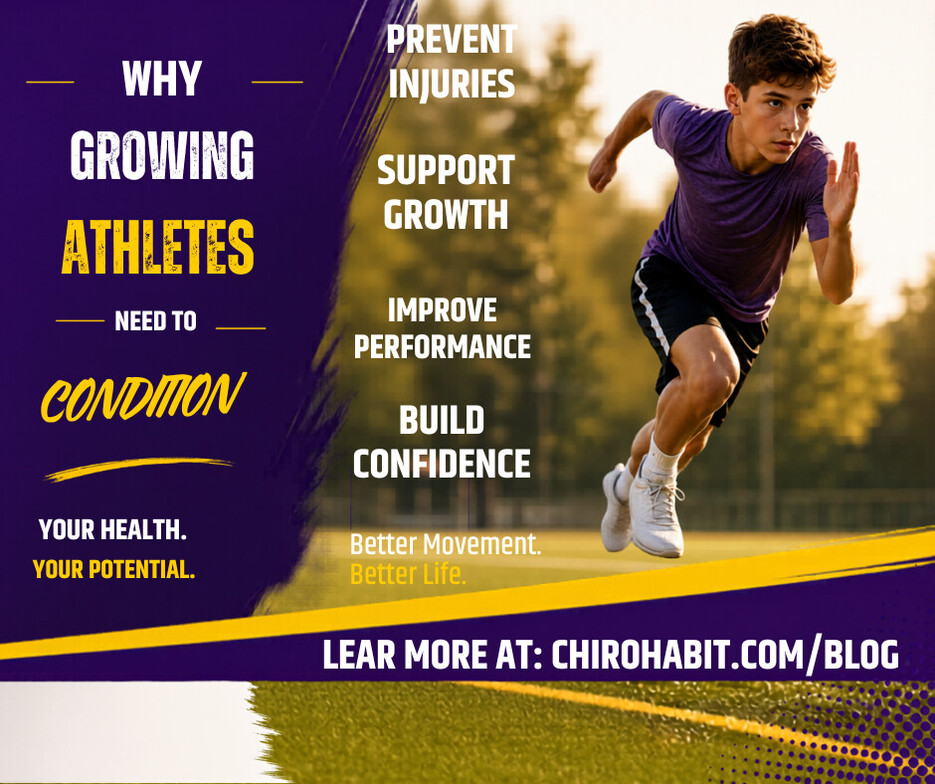
Why Growing Athletes Need More Than Just Practice to
Stay Healthy
Understanding the Science Behind Conditioning and Athletic Development
By Dr. John Giusti D.C., Chiropractor at ChiroHabit
One of the biggest mistakes I see in youth sports today is the belief that more practice automatically creates a better athlete.
Parents invest in lessons, travel teams, camps, and extra practice time because they want their children to succeed. While skill development is important, there's a piece of the puzzle that often gets overlooked:
A growing athlete's body must be physically prepared to handle the demands being placed upon it.
The reality is that practice develops skills. Conditioning develops the body.
If we want young athletes to stay healthy, prevent injuries, and perform at their best, we need to understand what is happening beneath the surface as they grow.
Growth Changes the Way the Body Moves
Children and teenagers aren't simply smaller versions of adults. Their bodies are constantly changing.
During growth spurts, bones often grow faster than muscles, tendons, and ligaments can adapt. This creates temporary imbalances throughout the body.
You may notice that an athlete who once seemed coordinated suddenly appears awkward or clumsy. Their stride may change. Their balance may be off. They may complain about tight muscles or new aches and pains.
This isn't because they are becoming less athletic.
It's because their nervous system is trying to learn how to control a body that has literally changed shape.
The brain constantly relies on information from muscles, joints, and the spine to determine where the body is in space. When growth happens rapidly, that information changes, and coordination can temporarily suffer.
This is one reason why conditioning becomes so important during adolescence.
Practice Repeats Movements. Conditioning Builds Capacity.
Think about a baseball player.
Practice teaches them how to throw, hit, and field.
What practice doesn't always do is build the physical qualities necessary to tolerate those repetitive movements safely.
Every athletic movement places stress on the body.
Running creates impact forces.
Jumping creates landing forces.
Throwing places stress on the bones, joints, muscles and tendons of the shoulder, spine, and hips.
The question isn't whether an athlete experiences stress.
The question is whether their body is prepared to handle it.
Conditioning helps improve:
- Muscular strength
- Joint stability
- Mobility
- Balance
- Endurance
- Recovery capacity
This allows the body to absorb force efficiently rather than compensating around weaknesses and creating imbalances.
Why Injuries Often Appear During Growth Spurts
Many common youth sports injuries aren't caused by a single traumatic event.
Instead, they develop because the body is repeatedly exposed to stress that exceeds its current capacity.
During growth spurts, several things happen:
- Bones lengthen
- Muscles become tighter
- Joint mechanics change
- Balance and coordination fluctuate
At the same time, many athletes are increasing practice hours, playing multiple sports, or competing year-round.
The result is a perfect recipe for overuse injuries.
This creates the enviornment for conditions such as:
- Osgood-Schlatter disease
- Sever's disease
- Shin splints
- Patellar tendon irritation
- Low back pain
These often occur because a growing body is struggling to keep up with the demands placed upon it.
Conditioning helps bridge that gap by improving the body's ability to tolerate stress.
The Nervous System Is the Foundation of Athletic Performance
As a chiropractor, I spend a lot of time educating patients about the nervous system because it controls every movement an athlete makes.
The brain is constantly gathering information from:
- The feet
- The joints
- The muscles
- The spine
This information helps determine:
- Balance
- Coordination
- Reaction time
- Body awareness
When athletes have poor movement patterns, restricted joints, or inadequate stability, the nervous system receives less efficient information.
Think of it like trying to use a GPS with poor signal.
The destination may be correct, but the directions become less reliable.
Conditioning helps improve the quality of information being sent to the brain, which ultimately improves movement efficiency and athletic performance.
Strength Is About More Than Muscle
Many people hear the word "strength" and think of lifting heavier weights.
For young athletes, strength is really about control.
Strong muscles help stabilize joints.
Stable joints move more efficiently.
Efficient movement places less stress on tissues.
For example, when the hips and core are strong, the knees often move better during running and jumping.
When the feet are stable, the knees, hips and spine doesn't have to compensate as much.
Strength is not simply about producing force.
It's about controlling force.
And that distinction is critical for injury prevention.
Recovery Is Where Adaptation Happens
One concept athletes and parents need to realize is this:
The body doesn't improve during training. It improves after training.
Practice and conditioning create stress.
Recovery allows the body to adapt to that stress.
Without proper recovery, the body remains in a cycle of breakdown rather than growth.
Recovery includes:
- Quality sleep
- Proper nutrition
- Hydration
- Mobility work
- Rest days
- Nervous system recovery
Athletes who ignore recovery often experience declining performance despite working harder.
The goal is not to do more.
The goal is to adapt better.
The Chiropractic Perspective
At ChiroHabit, we look at athletes movement as a complete package.
When a young athlete comes into the office, we don't just focus on symptoms.
We look at:
- How they move
- How they balance
- How their spine functions
- How their feet interact with the ground
- How their nervous system is adapting to growth and training
Our goal is to help athletes build a foundation that supports long-term performance and health.
Because athletic success isn't just about talent.
It's about having a body that can consistently perform, recover, and adapt.
The Bottom Line
Practice is essential for developing skills.
But skill development alone doesn't create a healthy athlete.
Growing athletes need strength, stability, mobility, balance, and recovery to support the demands of their sport and the changes occurring within their bodies.
Conditioning isn't extra training.
It's the foundation that allows training to work.
When athletes understand how their bodies function and build that foundation early, they don't just perform better—they stay healthier, recover faster, and enjoy sports for years to come.
— Dr. John Giusti, D.C
Chiropractor | Educator | ChiroHabit
"The better you understand your body, the better decisions you can make for your health and performance."

.jpg)