.png)
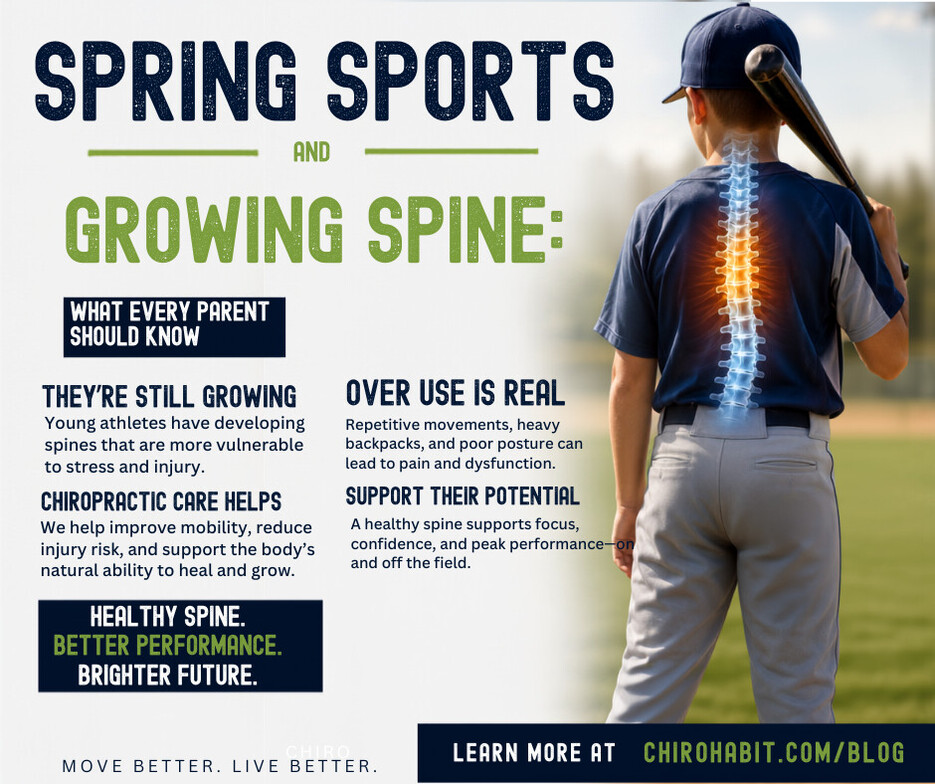
Spring Sports & Growing Spines: What Every Parent Should
Know
By Dr. John Giusti, D.C. Chiropractor at ChiroHabit
Spring sports are back, and for a lot of kids that means more time on the field, more competition, and more movement after a winter indoors.
It’s a great thing for health and development. But it also comes with something many parents don’t always realize:
A growing body doesn’t handle stress the same way an adult body does.
Understanding that difference makes it a lot easier to keep young athletes healthy through the season.
Growing Bodies Don’t Move the Same Every Month
Kids and teens are not physically “set” yet. They are constantly changing.
During growth, a few predictable things happen:
- Bones grow quickly
- Muscles lag behind slightly
- Coordination can feel “off” for a while
- Flexibility may decrease temporarily
This is why a kid can look smooth and athletic one month and then a little clumsy the next. It’s not regression—it’s adaptation.
The nervous system is basically learning a new version of the body in real time.
The Spine Is More Than Just the Back
A simple way to think about the spine is this:
It’s both a support system and a communication system.
It holds the body upright, but it also protects the nerves that control movement, balance, and coordination.
Every time a young athlete runs, jumps, throws, or twists, force travels through the spine. If everything is moving well, that force is absorbed and shared efficiently.
If something is off, the body starts compensating—usually without the athlete even noticing at first.
Why Spring Sports Can Catch the Body Off Guard
Most spring sports are repetitive:
- Baseball and softball = throwing and swinging over and over
- Soccer = sprinting, cutting, and kicking repeatedly
- Track = constant impact through running and jumping
- Tennis and golf = repeated rotation through the spine
That repetition is normal and even helpful—but only when the body is ready for it.
The problem shows up when training load increases faster than the body can adapt, especially during growth phases.
That’s when tightness, soreness, or fatigue tends to show up.
Growth Spurts Change Everything Temporarily
One of the biggest “hidden stressors” in youth sports is the growth spurt.
When a child grows quickly:
- Muscles feel tighter
- Joints may feel stiffer
- Balance can change
- Movement doesn’t feel as controlled
This is because the brain is constantly updating how it controls a body that has literally changed shape.
So even if strength hasn’t changed, coordination can temporarily drop.
That’s a normal part of development—but it does increase injury risk if training isn’t adjusted.
Practice Builds Skill. Conditioning Builds Capacity.
This is a key difference.
Practice helps athletes get better at their sport. It teaches timing, skill, and technique.
Conditioning builds the body’s ability to handle those skills.
Things like:
- Strength
- Stability
- Endurance
- Balance
- Control
Without conditioning, the body can “know what to do” but not be physically ready to do it repeatedly under stress.
That’s often when overuse injuries start to appear.
Recovery Is Where the Real Progress Happens
This is the part that gets missed most often.
Kids don’t get stronger during practice or games. They get stronger when they recover from them.
Recovery is when the body:
- Repairs muscle tissue
- Adapts to training
- Resets the nervous system
- Builds resilience
If there isn’t enough recovery time, the body starts stacking fatigue on top of fatigue. That’s when small issues turn into bigger problems.
Sleep, rest days, hydration, and downtime matter just as much as practice time.
Signs the Body Is Getting Overloaded
Pain is usually a late sign. The body gives earlier warnings like:
- Moving slower than usual
- Feeling stiff after activity
- Not recovering between practices
- Changes in running or jumping form
- Complaints of tight muscles or “soreness that sticks around”
These are often signs the body is working harder than it should just to keep up.
Why the Spine Matters So Much in Sports
The spine plays a big role in how efficiently a young athlete moves.
When it’s moving well:
- Balance is smoother
- Coordination is sharper
- Movement feels easier
- Less energy is wasted on compensation
When it’s restricted or stressed, other areas like the hips, knees, or shoulders often pick up the extra load.
That’s usually where discomfort starts.
Bringing It All Together
Spring sports are a great opportunity for growth, but growing athletes need more than just practice and competition.
They also need:
- Smart conditioning
- Enough recovery
- Awareness of how growth affects movement
When those pieces are in place, athletes tend to stay healthier, move better, and enjoy their sport more consistently throughout the season.
— Dr. John Giusti, D.C.
Chiropractor | Educator | ChiroHabit

.jpg)