.png)
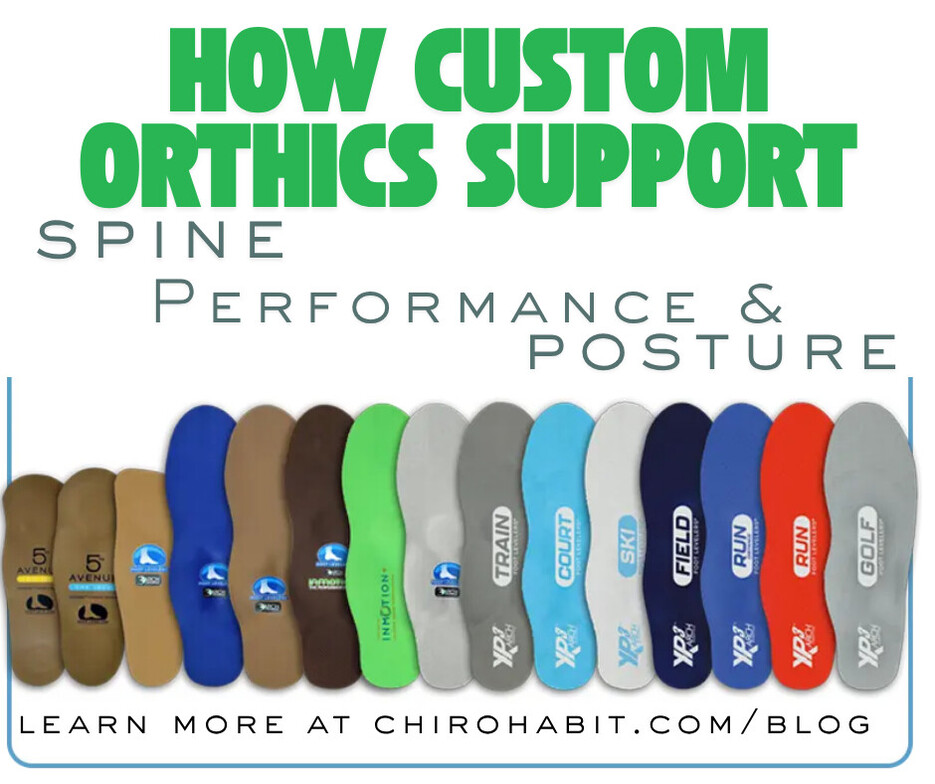
How Custom Orthotics Support Your Spine, Posture &
Performance
By Dr. John Giusti, D.C., Chiropractor at ChiroHabit
When patients hear the word “orthotics,” they often think of inserts for foot pain. While that’s part of the picture, it’s not the full story.
From a chiropractic perspective, custom orthotics are not just about the feet—they are about how the entire body moves, stabilizes, and performs under load. Because your feet are the foundation of your body, what happens at the ground level directly influences your spine, posture, and overall performance.
Everything Starts With the Ground
Every step you take creates a chain reaction.
Force travels from:
feet → ankles → knees → hips → pelvis → spine → head
If the foundation is unstable or inefficient, that force gets absorbed and redirected in ways the body was not designed to handle long-term.
Custom orthotics help by improving how your feet interact with the ground. Instead of collapsing, rolling, or compensating, the foot receives support that encourages more efficient alignment from the start of the chain.
What Custom Orthotics Actually Do
Custom orthotics are designed to match the unique structure of your feet. Unlike generic inserts, they are built to influence biomechanics in a precise way.
They can help:
- Support proper arch function
- Improve weight distribution
- Reduce excessive pronation or supination
- Enhance shock absorption
- Improve stability during movement
But more importantly, they help your body move with less compensation.
When the base is more stable, the rest of the body doesn’t have to work as hard to stay balanced.
How Foot Alignment Affects the Spine
The spine is constantly adapting to what is happening below it.
If the feet collapse inward, the knees rotate, the hips shift, and the pelvis tilts. That change travels upward and can lead to:
- Low back tension
- Pelvic imbalance
- Mid-back stiffness
- Neck strain from compensation patterns
Most people don’t realize their spinal discomfort may actually begin with repetitive stress patterns at the feet.
Custom orthotics help reduce those patterns by improving foundational alignment.
Posture Is a Chain Reaction, Not a Single Position
Many people think posture is something you “hold” with effort. In reality, posture is the result of how efficiently your body stacks itself under gravity.
When your feet are unstable, your posture requires constant muscular correction. That leads to fatigue and tension.
When your feet are supported properly:
- The pelvis sits more evenly
- The spine stacks more naturally
- The shoulders relax more easily
- The head requires less correction
Good posture becomes less of a struggle and more of an automatic response.
Performance Improves When Compensation Decreases
Whether you are walking, running, working, or training, your body performs best when energy is used efficiently.
Poor foot mechanics force the body to waste energy stabilizing instead of moving.
Custom orthotics can improve:
- Walking efficiency
- Running mechanics
- Balance and coordination
- Endurance and fatigue resistance
- Joint stress distribution during activity
When the foundation is stable, the body can focus more on performance and less on correction.
Orthotics and the Nervous System Connection
Your feet are packed with sensory receptors that constantly send feedback to your brain about balance and position.
When foot mechanics are improved, the nervous system receives cleaner, more accurate input. This can enhance:
- Balance control
- Coordination
- Reaction time
- Postural awareness
From a chiropractic standpoint, this is critical. The spine and nervous system work together—better input leads to better output.
Orthotics Are Not a Crutch—They Are a Tool
A common misconception is that orthotics “weaken” the feet. That depends on how they are used.
In a chiropractic model, orthotics are not meant to replace function—they are meant to reduce harmful compensation while the body is being retrained.
Think of them as:
- A stabilizing tool
- A corrective environment for movement
- A support system while the body adapts
When combined with adjustments, movement, and strengthening, orthotics can help retrain healthier biomechanics over time.
Why Custom Matters
Not all feet are the same. And not all movement patterns are the same.
Custom orthotics are designed based on:
- Foot structure
- Gait patterns
- Weight distribution
- Activity level
- Existing compensation patterns
That level of specificity is what allows meaningful change—not just temporary comfort.
The Chiropractic Perspective at ChiroHabit
At ChiroHabit, we look at orthotics as part of a larger system of care.
We don’t just ask, “Where does it hurt?”
We ask, “Where does the stress begin?”
Often, the answer starts at the foundation.
By combining chiropractic adjustments with improved foot mechanics, we aim to restore:
- Better spinal alignment
- Improved posture
- More efficient movement patterns
- Reduced chronic compensation stress
Everything in the body is connected, and the goal is always long-term function—not short-term relief alone.
The Bottom Line
Custom orthotics are more than foot support—they are a tool that can influence your entire kinetic chain.
When your foundation is more stable, your spine moves better, your posture improves, and your performance becomes more efficient.
If you’ve been dealing with recurring pain, fatigue, or alignment issues, it may be worth looking at what your body is standing on every single day.
Because better support at the ground level can change everything above it.
— Dr. John Giusti, D.C.
Chiropractor | Educator | ChiroHabit

.jpg)